

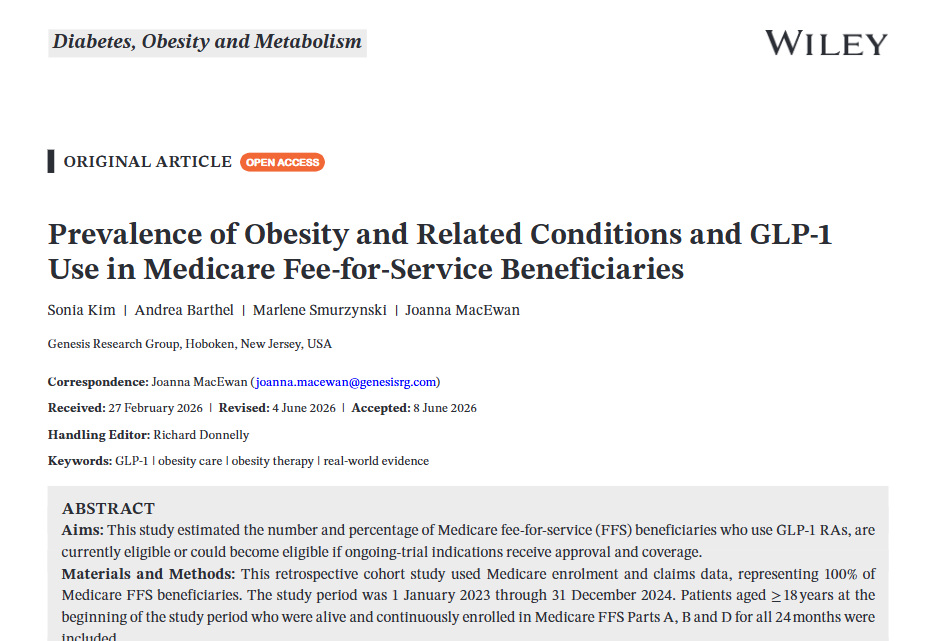
We are delighted to share that a recent real‑world evidence (RWE) study on GLP‑1 receptor agonists (GLP-1 RA), obesity and type 2 diabetes in the Medicare population has been published in Diabetes, Obesity and Metabolism. The work showcases GLP‑1 RA uptake by indication in a large, real‑world US dataset.
Our article, “Prevalence of Obesity and Related Conditions and GLP‑1 Use in Medicare Fee‑for‑Service Beneficiaries,” examines obesity, GLP‑1 RA use, and current and potential future eligibility for GLP‑1 RA therapies among Medicare fee‑for‑service (FFS) beneficiaries.
Aim
This study aimed to quantify, within the Medicare FFS population:
- The number and percentage of beneficiaries currently treated with GLP‑1 RAs
- The proportion with existing covered GLP‑1 indications, including type 2 diabetes and other cardiometabolic conditions associated with overweight and obesity
- The share of patients who could become eligible for GLP‑1 therapies if additional obesity‑related and cardiometabolic indications receive regulatory approval and coverage.
Materials and methods
Using a retrospective cohort design, the study leveraged comprehensive Medicare enrolment and claims data representing 100% of Medicare FFS beneficiaries with Parts A, B and D. The analysis covered 1 January 2023 to 31 December 2024 and included adults aged 18 years and older who were alive and continuously enrolled for the full 24‑month period, enabling robust HEOR insights into GLP‑1 RA use across multiple indications including obesity and type 2 diabetes.
Results
Among 16,474,786 Medicare FFS beneficiaries with Part D, 6.2% received GLP‑1 receptor agonists. Overall, 35.1% had at least one currently covered GLP‑1 indication, such as type 2 diabetes or other cardiometabolic conditions linked to overweight or obesity. However, only 16.5% of eligible beneficiaries had a GLP‑1 claim, underscoring a substantial treatment gap.
Real‑world evidence from the analysis showed that 76.9% of beneficiaries had at least one current or potential future GLP‑1 indication. An estimated 1.2 million people (7.0%) had obesity alone and were ineligible under existing policy. If coverage were expanded to include conditions such as heart failure with preserved ejection fraction, chronic kidney disease, psoriasis and knee osteoarthritis, roughly 35% of these currently ineligible beneficiaries (around 407,085 individuals) could gain access to GLP‑1 therapies.
Conclusions and implications
This RWE study provides a detailed view of how evolving Medicare coverage policies could impact access to obesity and treatments in routine practice. Broader eligibility through cardiometabolic and obesity‑related conditions has the potential to increase access to anti‑obesity medications for Medicare FFS patients, but real‑world uptake will depend on affordability, policy design and other access barriers. Further research is needed to assess the net clinical and economic value of GLP‑1‑based anti‑obesity medications in this population.
We congratulate authors Joanna MacEwan, Sonia Kim, Andrea Barthel and Marlene Smurzynski on this publication and their contribution to advancing RWE in GLP‑1, obesity and cardiometabolic care.
If you would like to discuss how our industry‑experienced experts can support your organization with GLP‑1 and obesity HEOR, RWE, or market access analytics, get in touch.
Read the full research article at Diabetes, Obesity and Metabolism
Explore our solutions | Sign up to our newsletter